
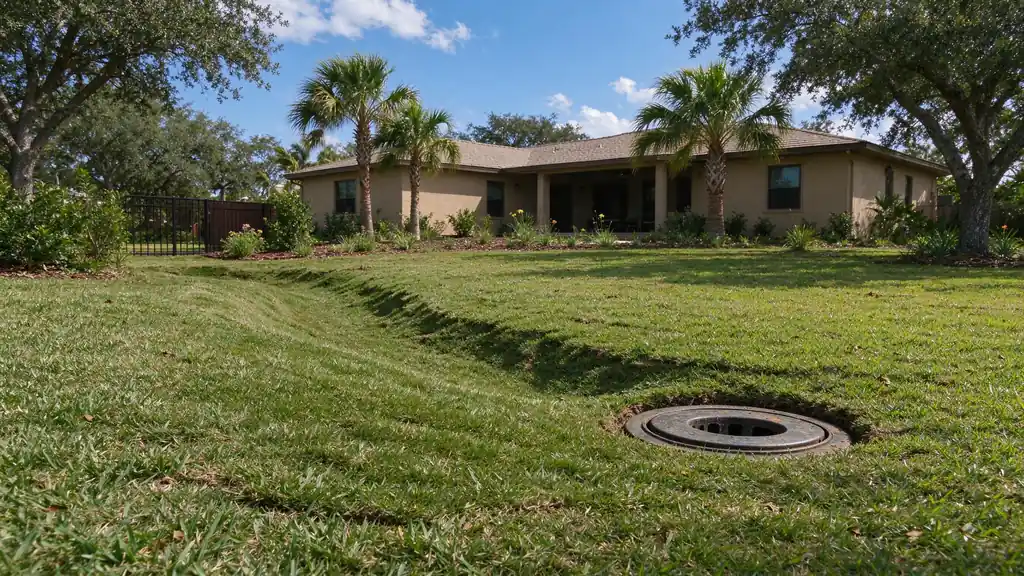
Southside drainage needs to consider the route beyond the individual yard. Quay offers private-property drainage assessment, installation and repair in Corpus Christi’s Southside, including properties whose runoff ultimately reaches the Oso drainage basin. The local decision is not simply which collector fits the lawn. It is whether that collector has a workable route to a receiving system during the conditions that create the problem.
The official Nueces County flood insurance study describes areas south of Padre Island Drive draining toward Oso Creek through storm sewers and open ditches. It also describes broad gentle slopes and potential lateral flooding along drainage ways in the Oso basin. Those are basin-level facts, not a diagnosis of every Southside lot. They explain why the receiving side deserves attention before a new private drain is selected.
Start with the property’s water pattern
Record where water first appears, which surfaces contribute and whether several areas become wet together. Roof outlets, a patio edge and higher ground can send water toward the same low lawn. A collector chosen only from the puddle location may miss the incoming route. The standing-water guide helps turn safe observations into a useful assessment record.
Include the apparent receiving side where it can be seen safely. Describe whether nearby visible drainage remains full while the yard is ponded, without entering a ditch or flooded area to investigate. A photograph taken when everything is dry cannot show the full receiving condition during rain. Keep observation and inference separate: water near a ditch does not establish the cause, capacity or ownership of that ditch.
Consider gentle slopes and the whole elevation route
Broad gentle terrain can leave little usable elevation difference between a collection point and its receiver. A pipe route that looks downhill from the surface may still contain a high point or end below the receiving water. Ask which levels will be measured and how the proposal maintains a continuous route through crossings, bends and the final connection.
The no-gravity-outlet guide explains why more pipe does not create fall. A deeper trench can make the final connection harder rather than more effective. If infiltration or pumping is proposed instead, it needs its own ground, overflow, operation and maintenance explanation. Neither should be selected merely because the first gravity alignment is inconvenient.
Separate private collection from receiving-system limits
A basin, channel or French drain changes collection on the property. It does not lower a full public receiving system or guarantee capacity in a downstream ditch. The Oso basin context is a reason to distinguish a private defect from wider receiving-water conditions. A repairable blocked pipe and a clear pipe unable to discharge during backup are different situations.
Read the private-drainage limits guide before comparing claims about flood prevention. A private proposal should identify what it can change and what remains outside its control. Where a public drainage concern is involved, keep its reporting and authority separate from the estimate for work inside the lot. No municipal civil construction is assumed within Quay’s private drainage scope.
Match the collector to the source
Surface runoff may need a catch basin, a channel or a changed surface route. Water within soil may justify a different assessment for a French drain. A downspout connection has the separate job of carrying concentrated roof water. Those choices can be combined, but their functions and connections should remain clear.
Avoid treating all Southside soil as one material or assuming infiltration performance from the city name. An actual ground assessment matters where a dry well or permeable collection zone is proposed. The dry-well and rain-garden guide explains storage, soil acceptance and overflow. The regional receiving basin does not establish the suitability of an infiltration installation on an individual property.
Confirm the project and jurisdiction
Southside work inside Corpus Christi should use the applicable city review path for its actual scope. Grading, public right-of-way work and qualifying development can involve different questions. The city’s flood-risk guidance directs owners to obtain a permit for regrading away from buildings. That does not mean every drain cleaning or small repair is identical to a development project.
The permit and outlet guide helps identify which authority and documents to confirm. A proposed connection to a public receiver is not assumed authorized. Temporary construction groundwater discharge is also distinct from the finished yard outlet. Ask who confirms those matters before the proposal depends on them and how any required work is included in the scope.
Plan access and a complete finish
A Southside project should reflect the actual property’s gates, paving, fixed equipment, planting and private services. Describe where equipment can enter and which areas must remain usable. Public utility location does not necessarily identify irrigation or private lighting. Share available records before the route is fixed so avoidable conflicts can be addressed in planning.
Agree how excavated material, equipment routes and disturbed surfaces are handled. Backfilled soil, new turf and replaced paving are different finishes. The installation and restoration guide helps define the handover rather than leaving it to assumptions. A collector may occupy a small visible area while its connected route requires substantial trenching elsewhere on the lot.
Compare scope and price without a false local average
No verified Southside installed-price band is available here. Length, depth, access, loading, surface cuts, receiving work and restoration affect the estimate. The cost guide includes clearly labeled national French-drain and channel-drain context. Those bands do not establish a local whole-yard quote or include every possible outlet improvement.
Use the estimate checklist to compare the same water route and finish. Ask which conditions are measured, which are assumptions and what happens if excavation reveals something different. A lower total that omits a viable receiving connection is not equivalent to a complete proposal. Include known existing lines or prior work in the request so reuse can be assessed rather than presumed.
Keep the completed route accessible
Identify grates, cleaning points and visible discharge locations at handover. Later paving, raised edging or landscape changes can alter the route or bury access. The maintenance guide explains safe surface checks. If several connected inlets remain full together, record the receiving conditions before assuming another collector is needed.
Nearby Flour Bluff has its own documented soil-layer and receiving-basin decisions; it should not be treated as the same local brief. For a Southside estimate, describe the address area, affected surfaces, rainfall timing, visible receiving side and access constraints. An accepted request confirms receipt, while any appointment, project scope and price still require separate arrangement.