
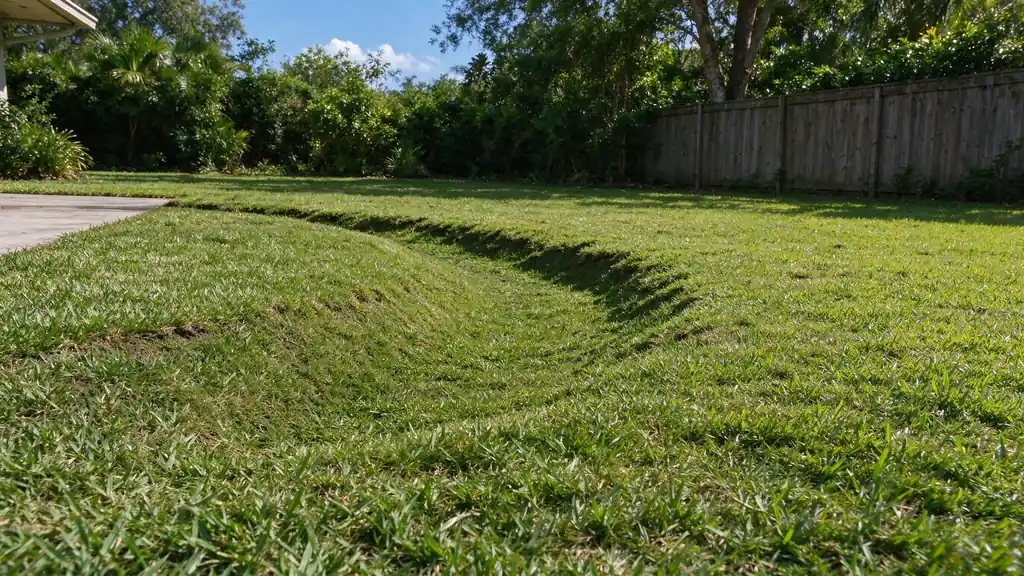
If a yard has no usable gravity outlet, first verify the elevations and receiving conditions. Infiltration, storage or pumping may be options, but each needs evidence, an overflow decision and maintenance responsibilities. No drain type creates a lower receiver, and a nearby street or water body is not automatic permission to discharge.
This guide supports the yard drainage service and the complete planning guide. Its purpose is to compare decisions before excavation, not prescribe a pump or dry well from a photograph. A route that appears unavailable by eye may need measurement, while a route that looks downhill may still fail at its final connection.
Verify whether gravity is actually available
Check the level at the collection area, the proposed pipe route and the final receiver. Crossings, high points and required depth can control the result. A deeper trench can reduce the usable fall at the end. Ask how the proposed arrangement relates to existing buildings, paving and utilities rather than assuming a long pipe can simply be buried deeper until it works.
Consider the receiver during the same weather that causes the yard problem. A dry outlet can look promising while a submerged one prevents discharge during rain. The inspection service can help distinguish measurements, observations and uncertainties. A controlling downstream level should be documented rather than disguised as a need for more collection capacity.
Treat infiltration as a ground-dependent decision
A dry well or infiltration trench stores water while the surrounding ground accepts it. Its volume is not the same as disposal capacity. Soil layers, groundwater and conditions at the proposed depth matter. A visible sandy layer or a neighbor’s installation is not sufficient evidence that the same approach will work on your property.
The dry-well and rain-garden guide explains those differences. Ask what testing or site evidence supports the proposal, where water goes if acceptance is slow and how sediment is kept from compromising the installation. Infiltration should not be located or connected in a way that simply returns concentrated water to the problem area.
Understand what storage can and cannot do
Storage can hold a defined volume temporarily, but it still needs an eventual route for the water to leave. Without infiltration, controlled discharge or another suitable mechanism, it becomes full. A tank or aggregate void volume should therefore be compared with the proposed emptying behavior and the next rainfall, not treated as an unlimited destination.
Ask how the expected inflow, usable storage and discharge are established. An illustration based on a chosen volume is not proof of capacity for an entire site. The estimate checklist helps distinguish a design assumption from a measured fact. Keep overflow and access visible in the proposal rather than relying only on the buried container’s dimensions.
Evaluate pumping as an operating system
Pumping introduces equipment, power, controls, access and a discharge route. The receiving location must still be appropriate and authorized. Ask who maintains the equipment, how a fault becomes apparent and what happens if power or the pump is unavailable. Mechanical discharge is not maintenance-free and should not be sold as a simple guarantee against all flooding.
A proposed pump needs to be selected for the actual task by the responsible professional. This guide does not provide a universal pump size or electrical specification. Keep any required electrical work and other trade responsibilities explicit. The installation guide helps coordinate the physical work without silently assuming that all associated services are included in one drainage price.
Keep overflow and neighboring property in view
Every conditional option should consider what happens when inflow exceeds acceptance, storage or pumping. Overflow should not be left to an accidental route toward a building, across an occupied path or onto a neighboring property. Existing drainage easements and historical flow may constrain the available arrangement.
The neighbor-runoff guide separates observation from legal conclusions. An option that protects one patch of lawn by transferring the problem elsewhere is not a complete drainage plan. Ask the proposal to identify the receiving route, its limits and the consequences of unavailable discharge before comparing products or excavation quantities.
Confirm approvals before relying on a connection
A street inlet, curb, ditch or coastal water body can look like an obvious destination without being an authorized private outlet. Grading, public right-of-way and construction groundwater discharge can involve distinct questions. The permit guide explains the documented Corpus Christi distinctions and the need to confirm the actual jurisdiction.
Public-system or coastal receiving water can also remain outside private control. The coastal-limit guide makes that boundary explicit. Compare prices only after the proposed option has a defined purpose, receiving route, operating responsibility and finish. The cost guide does not publish an invented local pump or infiltration band; those scopes need their own evidence and estimate.
Identify the sump assembly in a pumping proposal
A sump basin receives water for the pump; the pump moves it through the discharge system. Basin access, controls, power, suitable discharge and fault behavior belong in the same operating plan. Do not compare pump purchase prices as though they were complete installed drainage systems. Ask which trade handles electrical work and who remains responsible for maintenance, inspection and any equipment failure.