
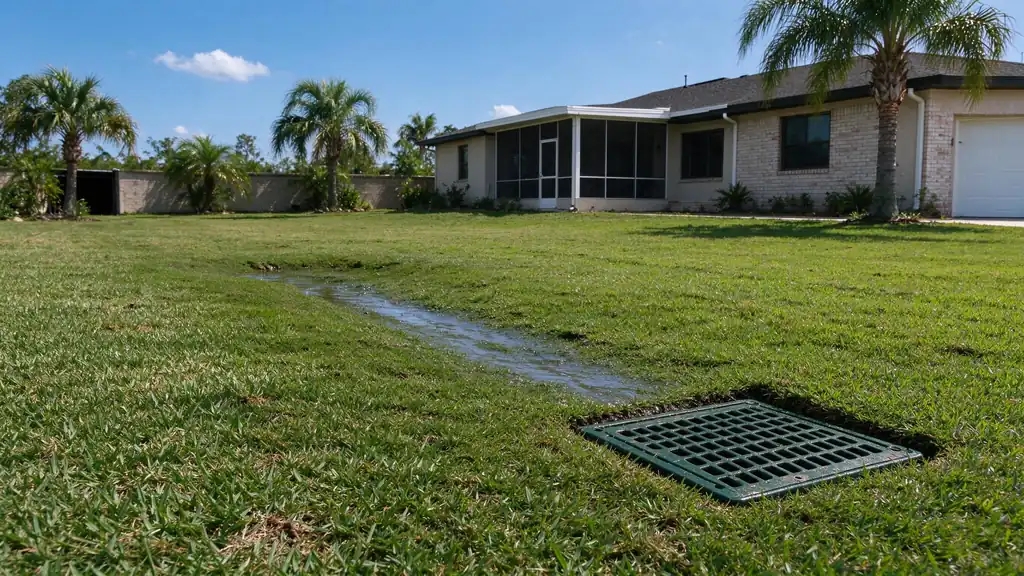
Dry wells and rain gardens can manage runoff only when ground acceptance, storage, overflow and maintenance suit the property. A dry well stores water below ground; a rain garden uses a planted surface depression with its own design requirements. Neither is an automatic solution for a yard without a gravity outlet.
This guide supports yard drainage and the no-outlet comparison. In Corpus Christi, conditions vary across the city and within a property. Do not treat visible sand, a regional soil label or a neighboring installation as proof that the proposed location and depth can accept the collected water.
Separate storage volume from emptying behavior
A structure can hold water without disposing of it quickly enough for its purpose. Its useful behavior depends on how water enters, how it leaves and what happens before the next rainfall. Aggregate voids or container volume are finite. A large excavation is not evidence of adequate infiltration, and a full storage space cannot keep accepting water indefinitely.
Ask how the proposal relates inflow, usable storage and ground acceptance. A calculation based on selected dimensions is an illustration unless the relevant site inputs support it. The estimate checklist helps identify which assumptions need confirmation. Keep the receiving mechanism explicit rather than allowing the word drainage to conceal that the system relies on infiltration.
Evaluate ground at the intended location and depth
Surface appearance can differ from underlying layers. Flour Bluff’s documented fine sands over clay at variable depths illustrate why the visible top layer alone is insufficient. That local fact should not be generalized to every Corpus Christi lot, nor should it be ignored when an assessment concerns Flour Bluff.
Groundwater and wet-period conditions also affect usable storage and acceptance. Ask what site evidence or testing supports the proposed method and which conditions could rule it out. No universal infiltration rate or installation depth is supplied here. A responsible proposal should make the basis of the decision understandable and state unresolved conditions before excavation is treated as a final solution.
Compare a dry well with a planted surface feature
A dry well receives and stores water below ground, with access and sediment management appropriate to the design. A rain garden uses a shaped planted area, with its own surface levels, growing conditions and overflow. The two may share a reliance on ground acceptance but are not interchangeable products or finishes.
Consider how the area is used and maintained. A planted feature needs a realistic care plan and suitable placement, while buried storage still needs a way to inspect or maintain relevant components. The grading service covers shaped surface routes, and French drain installation explains a collection trench that may convey water elsewhere rather than rely on local disposal.
Keep sediment out of the receiving system
Roof debris, loose soil and mulch can arrive with runoff. The collection and pretreatment arrangement should limit material that could reduce storage or ground acceptance. Ask which accessible areas collect sediment and how they are cleaned. A buried installation that cannot be maintained may become difficult to assess when performance changes.
The maintenance guide explains safe checks and recordkeeping. Stabilizing upstream ground can matter as much as cleaning the final structure. Do not assume a rain garden or dry well is maintenance-free because it uses natural ground processes. The proposal should describe the ordinary tasks and identify when professional investigation is appropriate.
Plan overflow and nearby property effects
Any infiltration feature needs to consider water that exceeds acceptance or storage. Identify where overflow travels and whether it approaches a building, boundary or occupied path. A feature intended to help one low spot should not simply move the uncontrolled water elsewhere. Existing drainage paths and permission may constrain the available arrangement.
Read the neighbor-runoff guide and permit guide before treating a convenient location as suitable. A buried structure close to the original problem may return collected water to the surrounding ground where it is unwanted. Placement should follow the complete water-management purpose rather than the easiest excavation access.
Compare evidence, scope and alternatives
If conditions do not support infiltration, consider the other options explained in the no-gravity-outlet guide. Pumping has different operating responsibilities; a gravity route still needs a suitable receiver. No option removes the need to understand where the water ultimately goes or what happens when that route is unavailable.
The cost guide does not publish an invented local dry-well or rain-garden band. Size, ground conditions, access, materials, collection, overflow and restoration can change the estimate. Use drainage inspections when the necessary site evidence is unresolved, and compare proposals by supported behavior and complete finish rather than container volume alone.
Distinguish other storage and groundwater proposals
Retention and detention describe different storage or release purposes and should not be used as interchangeable names for a small dry well. Ask what volume is held, how it empties and what approvals or professional design the actual arrangement requires. An infiltration trench similarly depends on ground acceptance along its receiving zone. Percolation testing can inform that decision when appropriately selected; a test result still needs interpretation for location, depth and relevant conditions.
High groundwater can contribute to subsurface saturation and reduce available acceptance. A sump-based discharge proposal may be considered conditionally, but the basin, pump, power, final receiver and maintenance need their own defined scope. It is not evidence that every wet area needs a pump or that groundwater can be discharged into a public system without authorization.