
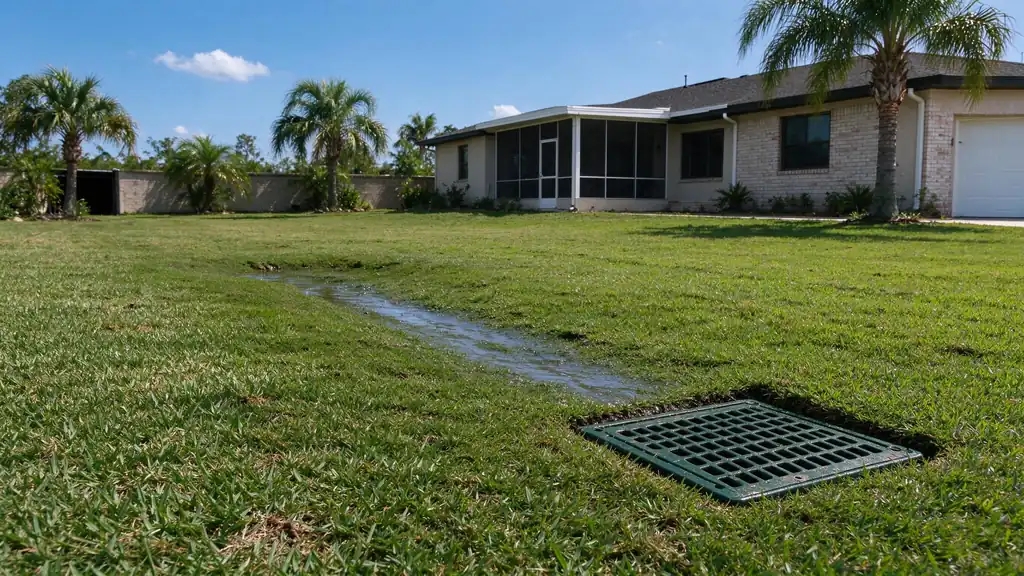
The Quay blog covers practical drainage observations, a clearly labeled illustrative project, published local code guidance and a recurring seasonal planning window. These articles support the deeper guides without inventing customer stories, crews, jobs or results. They help a Corpus Christi property owner prepare questions and records for private drainage work.
Use the guide hub for durable comparisons and technical decisions. Use the articles below when the question begins with a recent rainfall, a planned patio, preparation for construction or a recurring calendar reminder. Every article links back to the relevant service and explanatory guides so the next step remains clear.
Seasonal observations after heavy rain
After a heavy rain: what to record safely explains why timing and wider views are useful. A photograph of the deepest puddle shows a symptom but can leave out roof outlets, paving and the receiving side. The article helps separate observations from assumptions without asking the reader to enter unsafe water.
It also keeps dry-weather water and recent landscape changes in the record. Those details can alter the source question before a product is selected. The related standing-water guide provides a fuller record format, while drainage inspections explain what an actual assessment can establish and what remains outside its scope.
A start-to-finish illustrative walkthrough
Preparing a yard for drainage work is explicitly illustrative in its title, introduction and note. It represents no real homeowner, address, price, crew or outcome. Its purpose is to show the decisions that belong in an agreed scope rather than manufacture a case study where no verified job record exists.
The walkthrough moves from observations and receiver selection to access, utilities, installation, checks and restoration. It does not promise a timetable. The related installation guide explains the physical interfaces, and the estimate checklist helps compare responsibilities before work is authorized.
Published city guidance before patio planning
City drainage guidance to read before a patio project discusses the existing Corpus Christi island-development bulletin. It does not claim that the guidance was newly announced. The article explains why qualifying work, historical neighboring flow, approved discharge and final grades should be considered before paving fixes surface levels.
The North Padre Island brief supplies the local context. The article keeps unchanged repairs distinct from qualifying development and directs owners to confirm the actual requirements with the city. It does not turn one bulletin into a universal survey rule for every small yard project.
A recurring storm-season planning window
A recurring storm-season drainage check uses the official Atlantic hurricane-season window as a reminder to review accessible maintenance and records. It is not a storm forecast, emergency dispatch service or claim that tropical activity occurs only within those dates. Official safety guidance remains the authority for hazardous conditions.
The article separates routine private maintenance from control of coastal receiving water and public-system capacity. The maintenance guide explains safe tasks, while the coastal-limit guide defines the boundary. A cleaned grate or controlled test does not certify a property as flood-proof.
Keep articles connected to the actual water route
Reading about a situation is useful only if the next decision is clear. A source question may lead to yard drainage, a roof-water route to downspout drainage and an existing failure to repair. A product should follow the observed mechanism rather than be selected because it appears in a related article.
The complete drainage guide connects collection, conveyance, receiver and maintenance. The cost guide retains limited published national context without inventing local averages. Keep those limits visible when an article helps prepare a real estimate request.
Save notes and ask a defined question
The resources worksheet helps retain observations and compare proposals. The planning tools provide limited, explainable outputs without contact-gating their basic results. Neither an article nor a tool can certify concealed conditions, public capacity or the safety of unknown water.
When ready, use the estimate form to describe the property, timing, existing drainage and access constraints. You can begin with uncertainty rather than a diagnosis. Accepted submission confirms receipt only; appointment, scope, price and authorization need separate arrangement. That keeps the articles useful as preparation while leaving the actual construction decision tied to the actual property.
Each article has a different editorial job. The seasonal observation piece helps preserve evidence; the illustrative walkthrough explains a process without a fabricated result; the code-guidance article examines a real published local document; and the recurring-window article supports planned maintenance. Keeping those roles explicit avoids presenting four rewritten versions of the same service introduction.