
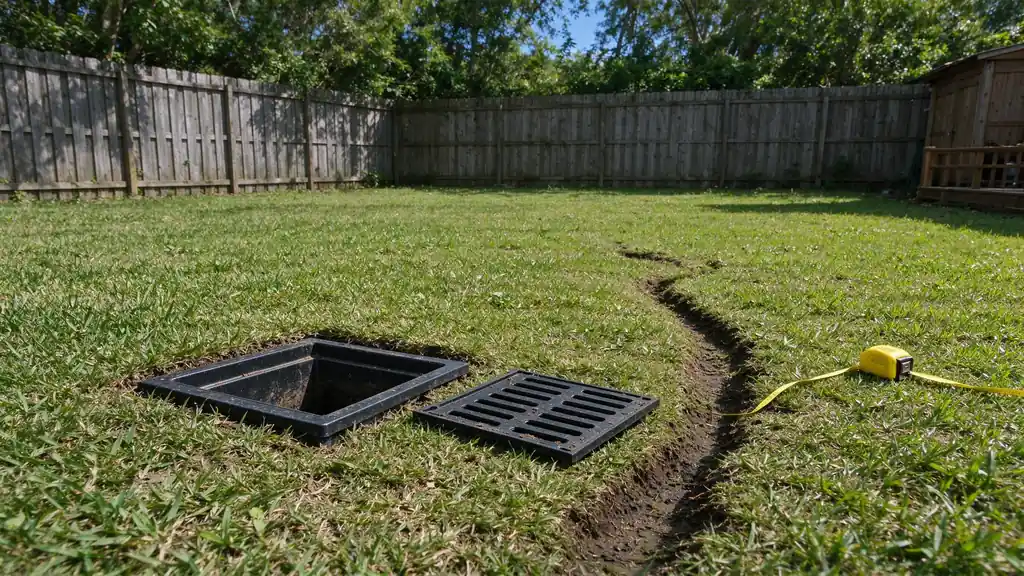
Compare drainage estimates by the complete water route and finished property, not the product name or total alone. Each proposal should identify source, collection, conveyance, receiver, access, approvals, checks, restoration and exclusions. Keep measured facts separate from allowances and unresolved conditions. A form request does not itself confirm an appointment, fixed price or authorization to start work.
This guide supports drainage inspections and the cost guide. It helps turn observations into a scope you can compare. Two prices can differ because the methods differ, but they can also differ because one stops before the receiving connection or leaves restoration and documentation to someone else.
Bring a source and rainfall record
Describe where water first appears, which surfaces contribute and when it recedes. Include dry-weather water and recent changes separately. Safe wide photographs can show roof outlets, paving and higher ground together. The standing-water guide provides a record format without asking you to diagnose the property.
Share existing plans, prior installation information and known access points. Label uncertain pipe routes as uncertain. An old invoice or visible cover may provide useful context without establishing the condition or destination of buried work. An assessment can then identify which questions need observation, measurement or further access before a final proposal is practical.
Ask what the collector is intended to receive
Surface basins, channels, swales and subsurface trenches have different jobs. Ask why the proposed method fits the observed water layer and location. The surface-versus-French-drain guide and basin comparison explain those mechanisms. Product size alone does not establish suitability.
The proposal should describe materials and installation support where relevant. For traffic areas, identify expected loading and the assembly around the grate. For subsurface collection, identify the filter and surrounding collection zone. Avoid comparing only a product purchase price with another contractor’s complete installed system.
Follow conveyance to the receiver
Ask where collected water travels and where it can discharge. The pipe guide distinguishes collection from conveyance. Check whether existing pipe is assumed reusable and what evidence supports that assumption. Junctions, bends and cleaning access should be understandable before backfill makes them invisible.
Receiving elevations and wet-weather behavior matter. The no-gravity-outlet guide explains why a long pipe is not automatically a workable outlet. A public inlet, neighboring line or water body should not appear as an assumed authorized destination. Identify any approval or permission dependency before treating the route as settled.
Compare access, excavation and approvals
List gates, paved crossings, fixed equipment, private services and areas that must remain usable. Ask what equipment access, spoil handling and protection are included. Public utility location does not identify every private line, so share available irrigation and electrical records. Do not move equipment or open ground to help the work before the responsibilities are agreed.
The permit guide separates grading, public right-of-way, qualifying island work and construction discharge. Confirm who obtains information and handles any required submission. Portland needs its own jurisdictional review. An unresolved approval should be visible in the proposal rather than hidden inside an unconditional installation promise.
Define checks, finish and exclusions
Ask what will be checked before concealed work is closed and what that check demonstrates. Controlled water movement is useful evidence but not a guarantee against every storm or elevated receiver. The installation guide covers those limits and the finish. Backfill, turf, planting and paving are separate inclusions to compare.
Identify work excluded from the drainage scope, including structural repair, sanitary sewer work or broader paving replacement where relevant. State who restores each interface if several contractors are involved. A proposal should also explain how concealed findings and scope changes are discussed and approved, rather than leaving the owner to infer the process from a total price.
Keep allowances and operating terms honest
A budget illustration is not a quote, and an allowance is not proof that an unresolved condition has been measured. The cost guide labels national context and illustrative arithmetic. No local rebate, financing, warranty, emergency attendance or free-estimate promise should be assumed unless explicitly supported and included in the actual terms.
Use the printable worksheet to record comparisons. Keep the accepted proposal, route information and maintenance handover together. The maintenance guide explains how access remains useful later. A sound comparison gives each price a defined purpose and boundary, so the decision rests on what will actually be built and restored rather than the most reassuring wording.
Ask each proposer to mark where its responsibility ends. That boundary can be a physical connection, a separate trade’s finish or an approval still to be obtained. Keeping it explicit helps prevent a price comparison from rewarding a scope that appears complete only because essential work has been left unnamed.