
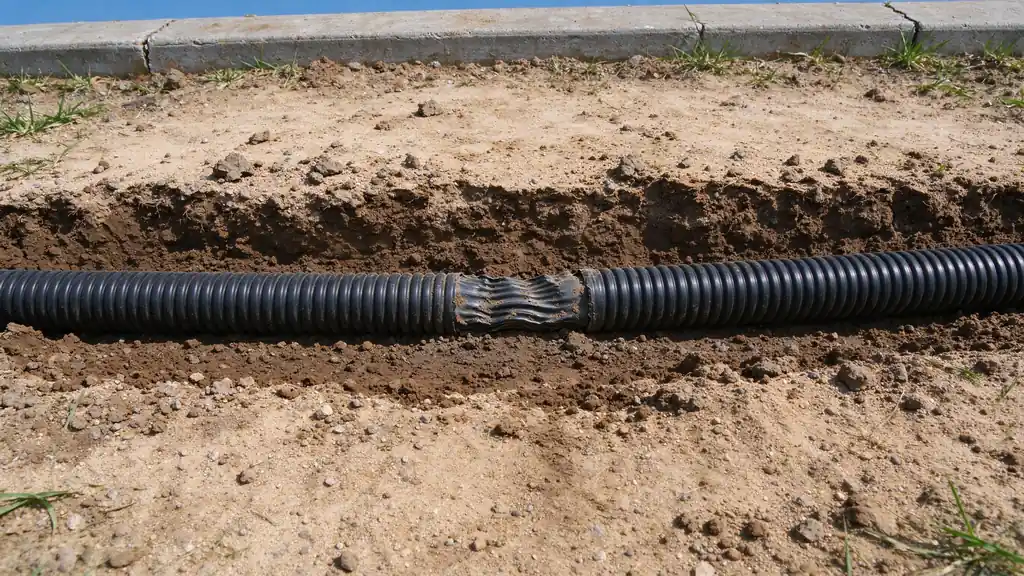
A French drain can fail to receive water, fail to convey it or fail to discharge at its outlet. Identify which part is limiting the system before choosing cleaning or replacement. A wet lawn alone does not establish a blocked pipe, and a clear pipe cannot correct unsuitable collection or receiving conditions.
This guide supports French drain installation and drainage repair. Begin with what changed, when the problem appears and which connected areas are affected. The aim is to match the response to an observed mechanism rather than assume that a larger or deeper replacement is always an improvement.
Check whether the trench receives the relevant water
A French drain is a subsurface collection zone. It may not receive fast surface runoff approaching across paving or a raised lawn edge. If the visible problem is water crossing the surface, a grate, channel or grade change may need consideration. The surface-drain comparison explains that difference.
The surrounding filter and aggregate also matter. Sediment entry or an unsuitable collection boundary can limit water movement even if the pipe remains open. Ask how the installed trench relates to the actual soil and water path. A product name or pipe diameter does not establish that the collection zone is in the right place or remains functional.
Separate restriction from damaged pipe
Sediment, roots, a separated joint, crushed material and poor fall are different findings. Each can influence the appropriate repair. Share any known route, installation record or accessible cleaning point. Do not assume a particular inspection method or cleaning tool is included until the scope identifies it and confirms that it suits the installed system.
An inspection should state what is observed, what can be checked and what remains concealed. A line that cannot be accessed may need additional investigation before a repair price can be defined. Avoid using an uncertain diagnosis as the basis for replacing the entire installation, but also avoid assuming that repeated cleaning will correct a damaged or wrongly routed section.
Observe the receiving outlet
A submerged or restricted receiver can keep a clear line full. Record whether several connected collectors back up together and whether the visible outlet is affected during the same rainfall. Safe observations help distinguish a local inlet issue from a shared downstream condition. Never enter moving or contaminated water to inspect the end of a pipe.
The no-gravity-outlet guide explains why replacement along the same route may leave the same limitation. The coastal-limit guide also separates private defects from receiving water outside the property’s control. More collection capacity does not lower an elevated receiver.
Review changes since installation
New paving, raised edging, planting beds or altered downspout connections can change where water travels. A system may now be receiving a different source or amount of surface flow. Later landscaping can also bury access or obstruct an outlet. Describe those changes even if they seem unrelated to the buried drain.
Check whether concentrated roof water has been connected to an unspecified perforated route. The pipe-function guide explains why collection and conveyance should remain distinct. A repair should preserve their intended jobs rather than introduce a new release of water near the area that needs to be kept serviceable.
Compare cleaning, localized repair and replacement
Cleaning may suit an established restriction in an otherwise appropriate route. A localized repair may suit an identified damaged section. Replacement may be considered where the route, materials, collection zone or access are unsuitable more broadly. Ask what each option changes and what known limitations it retains.
The repair service and estimate checklist help compare that evidence. A lower-disturbance option can be useful without being the right choice for every failure. A larger replacement is also not automatically justified. Keep the recommendation tied to findings and explain how concealed conditions may affect the final scope.
Check the repaired route and retain access
Agree what will be checked before backfill closes repaired connections. A controlled water check can help show intended flow or reveal a visible leak, but it does not reproduce every storm or receiving-water condition. Ask what the check demonstrates and what remains dependent on the site and its receiver.
The installation and restoration guide defines the finished property, while maintenance guidance helps prevent access from disappearing under later work. Retain the route and cleaning locations. The cost guide does not provide a universal repair price: investigation, depth, access, damage and restoration can make otherwise similar-looking failures very different projects.