
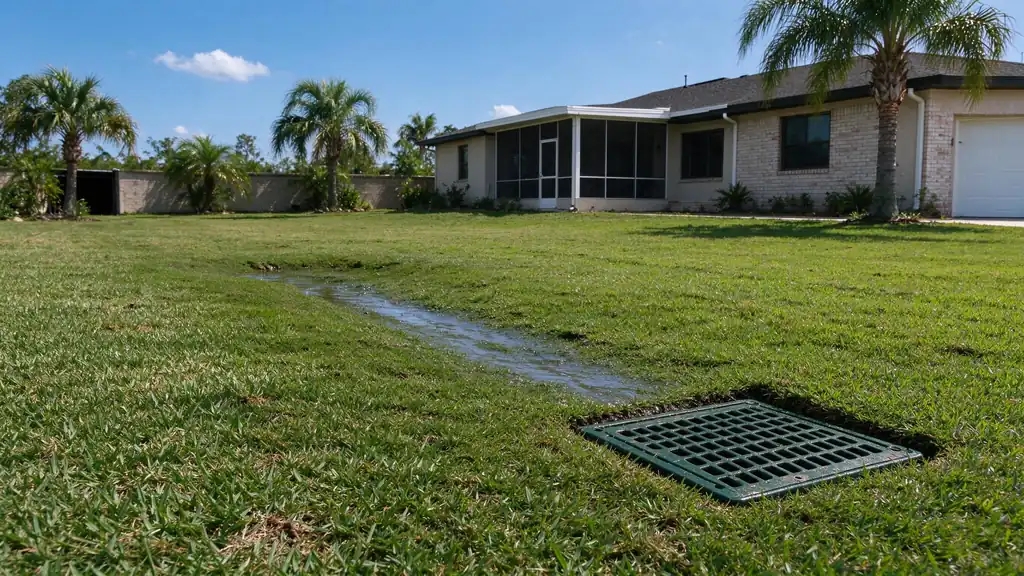
An illustrative yard drainage project begins with observations and a defined receiving route, then coordinates access, utilities, installation, checks and restoration. This walkthrough is not a completed Quay job or a customer story. Its purpose is to show the decisions a written scope should address before work is authorized on a real property.
Illustrative note: no homeowner, address, project dimensions, crew, price or result is being represented as an actual job. The sequence varies with site conditions and the agreed method. Use the yard drainage service and estimate checklist to compare the walkthrough with a proposal rather than treating it as a promised timetable.
Begin with the situation
In this example framework, the owner supplies safe observations of when water appears and which surfaces contribute. The record includes roof outlets, paving and any known existing drains. Unknown pipe routes remain labeled unknown. The point is to establish useful questions, not to declare from a photograph that a French drain or basin is required.
The standing-water guide shows how to prepare that information. An inspection can then distinguish observations, measured levels and unresolved conditions. If sanitary, supply-water or structural concerns appear, they remain with the appropriate provider instead of being silently included in the private rainwater scope.
Agree the collection and receiving purpose
The proposed method should explain what water it receives and where that water goes. Surface collection and subsurface interception are different mechanisms. The method comparison helps make that choice understandable. A drawing that only shows pipe length leaves the collection purpose and receiver insufficiently defined.
Before the scope is settled, check fall, outlet suitability and applicable permission. The permit guide and no-outlet guide explain those dependencies. This illustrative project does not assume a public connection, a universal infiltration rate or mechanical discharge without operating responsibilities.
Prepare access without creating new hazards
Identify gates, equipment routes, protected planting and surfaces that must remain usable. Share known irrigation, lighting and private utility information. Public utility location does not necessarily identify every private service. Do not dig to find a line or move fixed utility equipment before the relevant responsibilities are agreed.
The installation guide helps define those interfaces. Pets, movable belongings and ordinary garden items can be discussed in the access plan, but the owner should not be asked to perform hazardous dismantling or excavation. The proposal should make clear what preparation is expected and what remains the contractor’s work.
Keep installation details tied to function
During the agreed work, collection material, pipe type, connections and support should preserve the intended route. Perforated collection and solid conveyance should not be substituted indiscriminately. The pipe guide explains why a short change in material can alter where water enters or leaves.
Concealed conditions may require a revised decision. The scope should explain how changes are communicated and approved before additional work proceeds. This walkthrough does not invent an unexpected finding or claim a successful repair. It simply identifies why an honest change process belongs in the proposal alongside the initial design.
Check before closing the work
Agree the appropriate check for the installed or repaired route before backfill makes connections inaccessible. A controlled water check can demonstrate limited behavior under its conditions, but it does not reproduce every storm or receiving-water level. Ask what was checked and what remains dependent on the site or public receiver.
Restoration should also be compared with the written scope. Backfilled ground, turf, planting and paving are different finishes. A small visible collector may require disturbance along a longer route. The cost guide explains why access and reinstatement can make two apparently similar projects differ in price.
Retain a useful handover
The owner should be able to identify collectors, cleaning points, pipe direction and visible outlets after completion. Keep relevant records for future landscaping or paving so access is not buried and the surface route is not inadvertently changed. The maintenance guide explains safe checks and recurring-failure signals.
Use this illustrative sequence to ask better questions, not as evidence of a performed job or a promised result. A real request through the estimate form still needs its own property information, agreed appointment, scope and price. The useful outcome is a clearly defined project whose purpose, responsibilities, finish and limits can be understood before work begins.
For a real project, preparation should be written in terms the owner can follow safely: which ordinary belongings to move, which access to preserve and which areas to leave untouched. Confirm those instructions with the actual scope. This illustrative example does not assume that the owner supplies labor, excavates a trench or takes responsibility for locating concealed services.